Blend guide
IllumiNeuro
A four-peptide neuro-focused research blend built around cognition, learning, memory, stress-response pathways, neuroplasticity, neuroprotection, neural signaling, and healthy-aging research.
Start here
What exactly is IllumiNeuro?
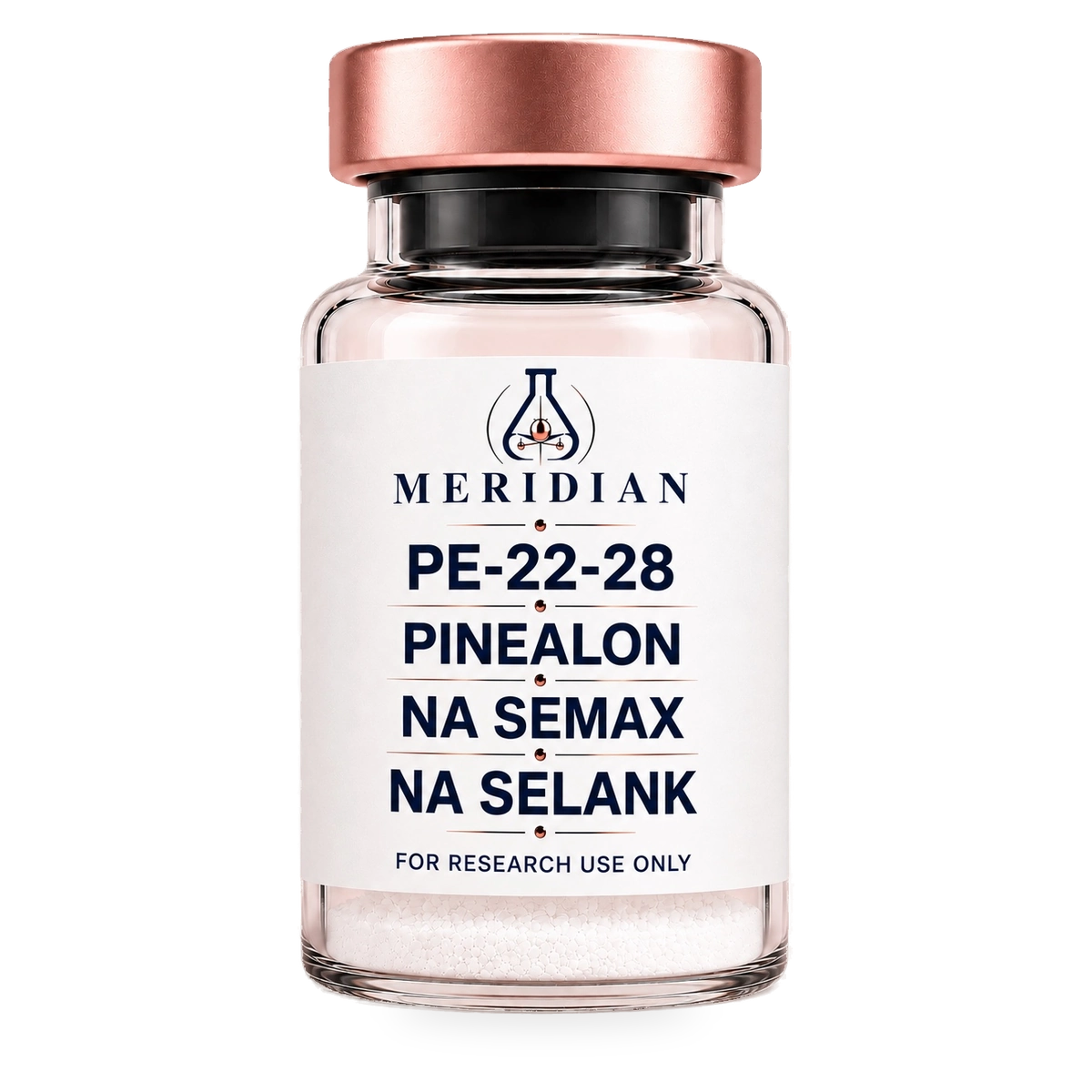
IllumiNeuro is a neuro-focused research formula that brings together four different peptides: PE-22-28, Pinealon, NA-Semax Amidate, and NA-Selank Amidate.
They are discussed together because each one approaches nervous-system research from a different direction. One is tied to a nerve-cell gate called TREK-1. One is tied to cellular stress and aging biology. Two are modified analogues from the Semax and Selank families.
The formula has a clear research story: signaling, adaptation, stress response, and cellular health.
Peptides 101
First, what even is a peptide?
Amino acids are like letters. Peptides are short words made from those letters. When the letters are arranged in different ways, they can carry different biological messages.
Researchers study peptides because some can interact with receptors, enzymes, signaling systems, or cellular processes. In plain English, that means a peptide may help scientists ask how cells communicate, respond to stress, or change over time.
Meet the four
Four Peptides. Four Research Directions.
This is a simplified map of the formula and the main scientific questions each ingredient is connected to.
TREK-1 • Neural signaling • Neurogenesis research
Cellular signaling • Oxidative stress • Aging biology
Cognition • Neurotrophic signaling • Neuroplasticity research
Stress response • Neurotransmitter signaling • Cognitive research
Why researchers are interested
What are scientists actually interested in?
These cards explain why the ingredients are relevant to each area and how the scientific ideas connect.
Cognition & Learning
Semax-family research is often discussed with neurotrophic signaling, while PE-22-28 research connects to neural signaling and new-cell formation in preclinical models.
Focus & Attention
NA-Semax Amidate is included because the Semax family is often discussed in attention and mental-workload research. The amidated analogue is a related area of study.
Memory & Recall
Memory research often looks at neuron survival, synaptic connections, and brain adaptability. Several IllumiNeuro components touch those scientific questions from different angles.
Stress Response
NA-Selank Amidate sits in a Selank-related lane where scientists study stress-response pathways and neurotransmitter signaling.
Neuroprotection
Neuroprotection means studying how nerve cells respond to stress or injury. Pinealon, Semax, Selank, and spadin-family papers each connect to this broad question in different models.
Neuroplasticity
Neuroplasticity is the brain’s ability to change. Semax-family and TREK-1 research are interesting because they connect to signaling involved in adaptation and connection-building.
Healthy Brain Aging
Pinealon is often discussed in aging-biology research because of cellular stress, oxidative-stress pathways, and neuronal-cell questions.
Mood & Neurological Signaling
TREK-1 and GABA-related systems are examples of pathways tied to nerve-cell signaling, which makes them interesting in preclinical neuroscience.
Read the research
Go deeper.
These source cards link to primary papers used for this guide. They are included for readers who want to explore the science behind each research lane.
Shortened Spadin Analogs Display Better TREK-1 Inhibition, In Vivo Stability and Antidepressant Activity
2017 • Studied shortened spadin analogues, including PE-22-28, in TREK-1, stability, neurogenesis, and preclinical signaling models.
Read the study →Animal + laboratoryIn vitro and in vivo regulation of synaptogenesis by the novel antidepressant spadin
2015 • Explored spadin, a related parent compound, in synaptogenesis and nerve-cell signaling models.
Read the study →Animal + laboratoryPinealon protects the rat offspring from prenatal hyperhomocysteinemia
2012 • Examined Pinealon in an animal model connected with neuronal stress, learning measures, and oxidative-stress markers.
Read the study →AnimalSemax and Pro-Gly-Pro Activate the Transcription of Neurotrophins and Their Receptor Genes after Cerebral Ischemia
2009 • Studied standard Semax, the parent peptide family, in neurotrophin and BDNF-related signaling after an animal brain-injury model.
Read the study →Animal + laboratorySelank Administration Affects the Expression of Some Genes Involved in GABAergic Neurotransmission
2016 • Looked at standard Selank and gene expression related to GABAergic neurotransmitter signaling in an animal model.
Read the study →LaboratoryGABA, Selank, and Olanzapine Affect the Expression of Genes Involved in GABAergic Neurotransmission in IMR-32 Cells
2017 • Studied standard Selank in a controlled cell model involving GABA-related gene-expression questions.
Read the study →Interested in the formula?
Explore IllumiNeuro with the same Meridian quality standard.
Third-party tested. Endotoxins and heavy metals screened. COA available upon request.
For research use only. The information in Discover is provided for educational purposes and summarizes areas of published and emerging research. It does not establish that IllumiNeuro or its individual components are safe or effective for treating, preventing, or diagnosing any disease.