
Discover
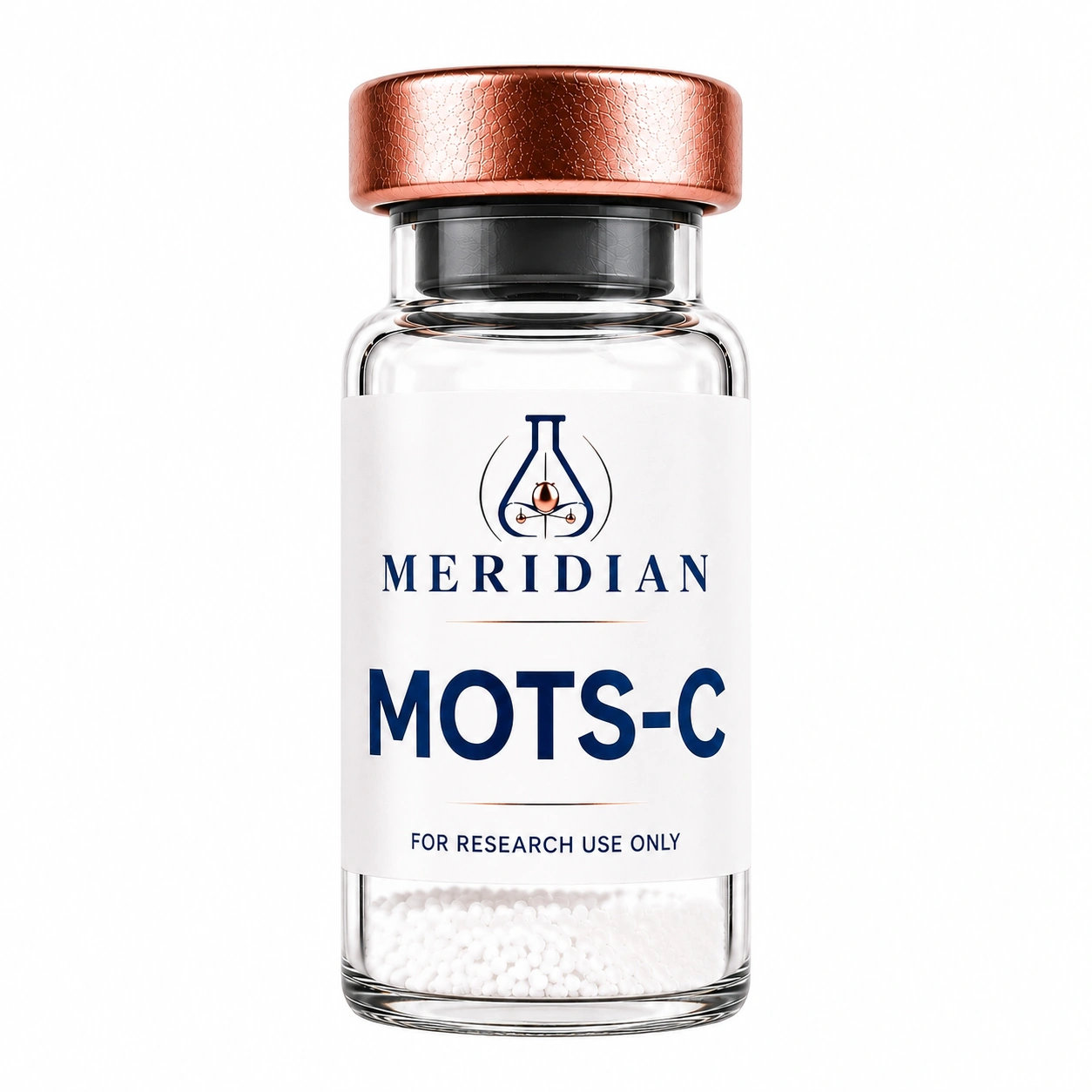
MOTS-C
The fascinating science behind metabolism, exercise endurance, stamina, cellular energy, and healthy aging.
Remember when you could finish an intense workout, go about your day, and still have energy left for everything else?
Now, sometimes, climbing a few flights of stairs feels like a workout of its own.
Maybe you’re staying active, watching what you eat, and doing everything you can to maintain your energy and fitness. But you’ve noticed something interesting: your body doesn’t always respond the way it used to.
And that raises a fascinating question.
What if the secret to understanding endurance, metabolism, and physical aging begins deep inside our cells?
Scientists have been investigating exactly that.
One peptide attracting attention in this field is MOTS-C, a naturally occurring molecule connected to mitochondrial signaling, metabolic regulation, and the body’s response to exercise.
And here’s what makes it particularly interesting:
Researchers have discovered that our bodies naturally increase MOTS-C levels in response to physical activity. Exercise research
That finding has opened an entirely new conversation about how mitochondria communicate with the rest of the body.
Meet MOTS-C: A Different Kind of Peptide
MOTS-C stands for mitochondrial open reading frame of the 12S rRNA-c.
Quite a mouthful, right?
Fortunately, the science behind it is more interesting than the name.
MOTS-C is a naturally occurring peptide made of 16 amino acids. It was first described in a groundbreaking study published in Cell Metabolism in 2015. Read the discovery study
What makes MOTS-C unusual is its origin.
Its genetic instructions are found in mitochondrial DNA, the small amount of genetic material located within our mitochondria.
Most people know mitochondria as the powerhouses of our cells.
They help convert nutrients into ATP, the energy currency our cells use to perform essential functions.
But scientists have discovered that mitochondria do much more than produce energy.
They also send signals that help cells respond to changing metabolic conditions.
And MOTS-C appears to be part of that communication system. Mitochondrial signaling research
The Exercise Connection: Why MOTS-C Is Getting Attention
Here’s where the research becomes especially fascinating.
We already know that exercise does more than burn calories.
Physical activity changes the way our muscles use energy, how our cells respond to stress, and how the body adapts over time.
But scientists wanted to understand whether MOTS-C participates in those changes.
In a 2021 study published in Nature Communications, researchers examined MOTS-C levels in healthy young men who completed a stationary cycling exercise session.
They collected muscle and blood samples before and after exercise.
The findings were remarkable.
MOTS-C levels in skeletal muscle increased approximately 11.9-fold following exercise.
Circulating MOTS-C levels also increased, approximately 1.6-fold during exercise, before returning toward baseline during recovery. Read the 2021 study
These findings suggest that MOTS-C is responsive to physical activity.
Another human exercise study, involving 30 participants divided among endurance exercise, resistance exercise, and control groups, also investigated mitochondrial-derived peptides.
That study observed a trend toward increased circulating MOTS-C after endurance exercise, though the change was not statistically significant. Read the human exercise study
Together, these findings have encouraged researchers to explore whether MOTS-C participates in the body’s adaptation to physical challenges.
The studies measured the MOTS-C naturally produced by participants. They did not test whether administering synthetic MOTS-C improves exercise performance.
Metabolism: How the Body Uses Energy
You hear the word metabolism everywhere.
Speed up your metabolism. Boost your metabolism. Fix your metabolism.
But what does metabolism actually mean?
Put simply, metabolism includes the chemical processes your body uses to convert nutrients into energy, build and maintain tissues, and support essential functions.
It’s constantly happening, whether you’re sleeping, sitting at your desk, or running on a treadmill.
MOTS-C has attracted attention because researchers have observed its interaction with a major cellular pathway called AMPK.
Think of AMPK as one of the body’s energy sensors.
When cellular energy availability changes, AMPK helps coordinate how cells respond, including processes involving glucose and fat metabolism.
Laboratory studies have found that MOTS-C can influence AMPK-related signaling. Metabolic signaling study · Cellular stress study
This has led scientists to investigate its relationship with:
- Glucose metabolism: How cells use glucose as fuel.
- Insulin sensitivity: How effectively cells respond to insulin.
- Fat metabolism: How the body processes and utilizes fats.
- Metabolic flexibility: How the body adapts its fuel use to changing conditions.
- Cellular stress responses: How cells adjust when energy demands increase.
These are important areas of metabolic research, especially as scientists investigate why these processes change with age.
MOTS-C and Fat Metabolism: What Did Researchers Discover?
One of the earliest MOTS-C studies produced particularly interesting results.
In 2015, researchers investigated how MOTS-C affected mice exposed to a high-fat diet.
The study found that MOTS-C-treated mice were protected against certain diet-related metabolic changes, including excess weight gain and insulin resistance. Read the mouse study
Researchers also observed changes in glucose utilization and energy expenditure.
Interestingly, some experimental groups consumed similar amounts of food despite differences in weight gain.
This suggested that the findings involved more than appetite regulation alone.
The research raised questions about how mitochondrial signals influence energy balance and nutrient metabolism.
The bigger scientific question is how mitochondrial signaling may influence the body’s ability to manage energy.
Endurance, Stamina & Physical Performance
Anyone who exercises regularly understands that stamina is about more than strength.
It’s the ability to keep moving, maintain effort, and recover between physical challenges.
Researchers have been investigating the role of mitochondrial function in these processes for decades.
In 2021, scientists published a study examining MOTS-C and physical performance in mice of different ages.
The researchers evaluated young, middle-aged, and older animals.
They reported improvements in physical performance among MOTS-C-treated groups.
Even more interesting, some very old mice showed improved physical capacity after receiving MOTS-C in experimental conditions. Read the animal findings
Researchers also observed changes involving muscle metabolism and the cellular pathways associated with adaptation to physical stress.
These findings suggest that MOTS-C may participate in biological processes involved in physical performance.
What About Aging and Longevity?
Aging affects much more than our appearance.
Over time, our cells experience changes in energy metabolism, mitochondrial function, muscle maintenance, and responses to biological stress.
This is why scientists have become increasingly interested in the relationship between mitochondria and healthy aging.
One research question is whether the body’s natural MOTS-C signaling changes with age.
Experimental studies have reported differences in MOTS-C levels and activity in aging models. Aging-model research
Researchers have also investigated how MOTS-C influences communication between mitochondria and the cell nucleus, where most of our genetic information is stored.
In a 2018 study published in Cell Metabolism, scientists observed that MOTS-C could move into the cell nucleus in response to metabolic stress and influence gene expression. Read the nuclear-signaling study
That finding suggests a fascinating possibility: mitochondria may communicate information about their metabolic condition to other parts of the cell through peptides such as MOTS-C.
This could help researchers better understand how cells respond to stress and changing energy demands.
MOTS-C is therefore being investigated not simply as an energy-related molecule, but as part of the wider biology of aging and cellular adaptation.
Its role in extending human lifespan or slowing human biological aging has not been demonstrated.
What Are People Actually Experiencing With MOTS-C?
Outside scientific research, MOTS-C has become a popular topic in fitness, longevity, and peptide discussion communities.
People are particularly interested in energy, endurance, workout performance, and metabolic health.
The personal experiences are varied.
Experience A: Feeling more capable during exercise
In a public Reddit discussion, an individual described repeatedly improving their cycling times while trying MOTS-C.
The person reported personal bests on familiar rides and changes in their heart-rate readings.
However, the account also mentioned previous use of other peptides and changing ride conditions. Exercise performance can fluctuate for many reasons, and this experience cannot establish what caused the improvement.
Experience B: More energy, then a completely different response
In a September 2025 discussion, one individual described an initial feeling of improved focus, motivation, and energy.
But the experience changed.
After subsequent administrations, the same individual described feeling unwell, experiencing injection-site soreness, and no longer noticing the earlier energy-related effects.
It’s an interesting reminder that personal experiences can change over time.
Experience C: Easier workouts versus unexpected fatigue
In a January 2026 community discussion, one contributor described a slight energy boost and easier workouts after adding MOTS-C following a period on SS-31.
The original poster described the opposite: considerable afternoon exhaustion.
These conflicting accounts illustrate the range of experiences people report. Concurrent compounds make it particularly difficult to isolate the effects of MOTS-C.
Experience D: No noticeable improvement
In another public discussion, an individual reported no improvement after a short period using SS-31 and MOTS-C for fatigue.
They also described a hard, itchy lump around the MOTS-C injection site that persisted for days.
Other contributors in the same discussion reported different experiences, including perceived improvements in workout energy.
These experiences help explain why MOTS-C attracts attention, but they cannot establish effectiveness, safety, or typical outcomes.
MOTS-C vs. SS-31: What’s the Difference?
MOTS-C and SS-31 are frequently discussed together because both are associated with mitochondrial research.
But they are not the same.
MOTS-C
MOTS-C is a naturally occurring mitochondrial-derived peptide involved in signaling pathways associated with metabolism, energy sensing, and cellular adaptation. Signaling research
SS-31
SS-31, also known as elamipretide, is a synthetic peptide investigated for its interaction with cardiolipin, a specialized lipid located within the inner mitochondrial membrane. Membrane research
An easy way to understand the distinction:
MOTS-C is studied for how mitochondria communicate metabolic information to the rest of the cell.
SS-31 is studied for how a peptide interacts with the structure and function of mitochondrial membranes.
Both have generated scientific interest, but their mechanisms and clinical evidence are different.
What Does Human Research Actually Show?
This is one of the most important distinctions in MOTS-C research.
Scientists have studied naturally occurring MOTS-C in humans, including its relationship with exercise and certain metabolic conditions. Human exercise findings · Endurance exercise study
A trial listing for administered MOTS-C in adults with prediabetes and overweight or obesity has been reported under NCT07505745. Its current recruitment status and results availability have not been independently confirmed here. Trial registration alone does not establish clinical benefit. Read the trial record
Frequently Asked Questions
Is MOTS-C naturally produced by the body?
Yes. MOTS-C is a naturally occurring peptide encoded by mitochondrial DNA and has been identified in human tissues and circulation. Discovery study
Does exercise increase MOTS-C?
Some human studies have reported increased endogenous MOTS-C levels following exercise, particularly after intense cycling. Researchers are still investigating how these responses vary. Cycling study · Endurance study
Is MOTS-C being researched for endurance?
Yes. Animal studies have reported improvements in physical performance, while human research has investigated the natural MOTS-C response to exercise. Read the research
Does MOTS-C help with fat metabolism?
Laboratory and animal research has identified effects on pathways involved in glucose utilization, insulin sensitivity, and fat metabolism. Human clinical benefits have not been established. Preclinical findings · Human trial record
Does MOTS-C increase energy?
MOTS-C is involved in cellular metabolic signaling, and some online users report changes in perceived energy. Controlled human trials have not established that MOTS-C administration increases everyday energy levels.
Is MOTS-C the same as a GLP-1 peptide?
No. MOTS-C is a mitochondrial-derived signaling peptide. GLP-1 receptor agonists act through a different hormonal pathway associated with glucose regulation and appetite.
The Bigger Picture
The human body is remarkably good at adapting.
Every time we exercise, recover, eat, or respond to physical stress, our cells make countless adjustments to manage their energy needs.
Mitochondria are central to those processes.
And MOTS-C has given researchers an exciting new perspective on how these tiny cellular structures may communicate with muscles and other tissues.
From exercise-induced changes in humans to intriguing discoveries involving metabolism and physical performance in animal studies, MOTS-C has opened important questions about cellular adaptation.
Perhaps the most fascinating part of the research is discovering that our mitochondria do more than power our cells. They may also help coordinate how the body responds to exercise, metabolic stress, and aging.
And that’s what makes MOTS-C such an interesting part of modern metabolic research.
Scientific References
- Lee C, et al. (2015). The Mitochondrial-Derived Peptide MOTS-c Promotes Metabolic Homeostasis and Reduces Obesity and Insulin Resistance. Cell Metabolism. Read the study
- Kim KH, et al. (2018). The Mitochondrial-Encoded Peptide MOTS-c Translocates to the Nucleus to Regulate Nuclear Gene Expression in Response to Metabolic Stress. Cell Metabolism. Read the study
- Reynolds JC, et al. (2021). MOTS-c Is an Exercise-Induced Mitochondrial-Encoded Regulator of Age-Dependent Physical Decline and Muscle Homeostasis. Nature Communications. Read the study
- Acute Endurance Exercise Stimulates Circulating Levels of Mitochondrial-Derived Peptides in Humans (2021). Read the human exercise study
Related reading
For educational discussion only, not medical advice or a recommendation for self-experimentation. Meridian Research materials are for laboratory research use only.