Discover
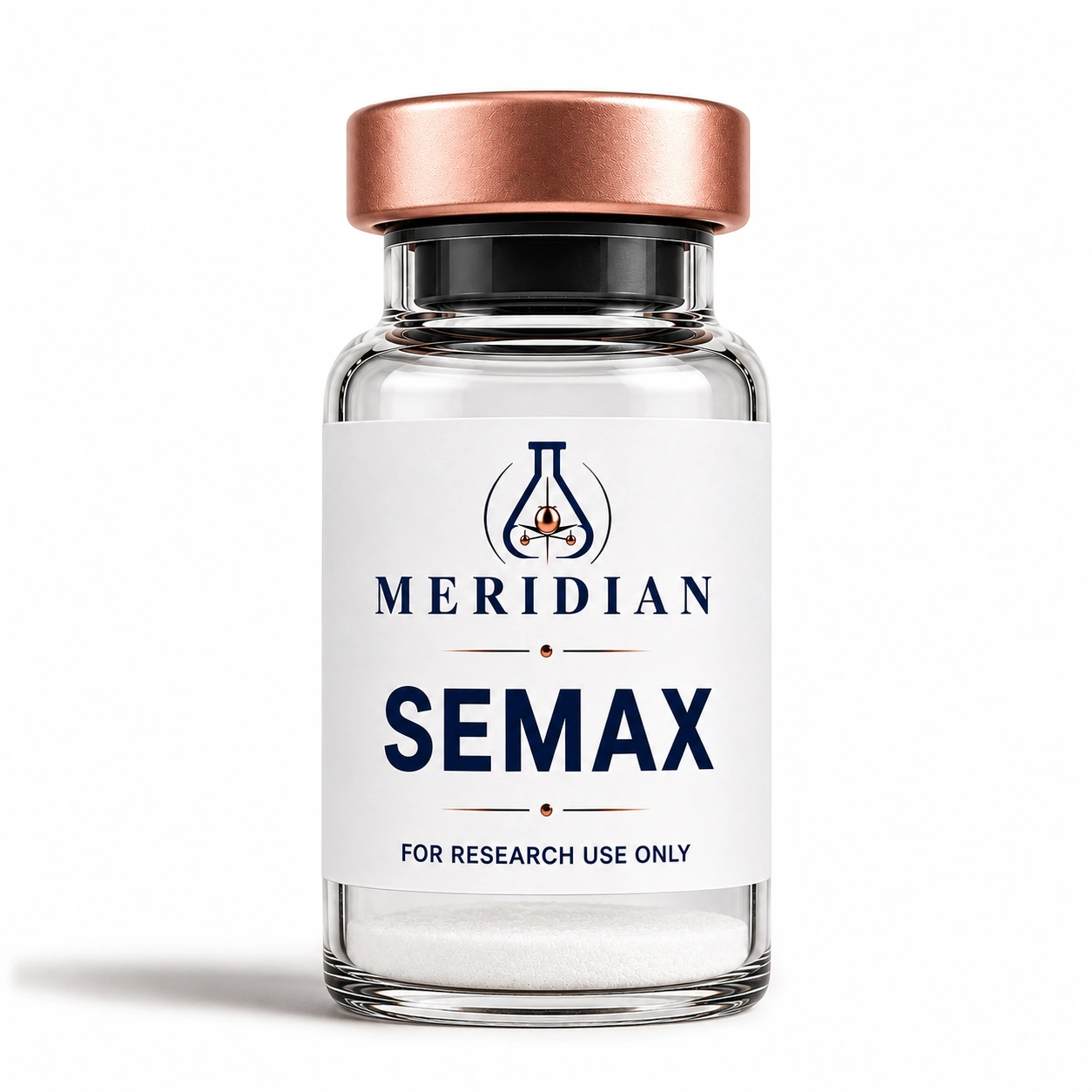
Semax
Exploring the science of focus, memory, motivation, and the brain’s remarkable ability to adapt.
Ever have one of those days when your mind is everywhere except where you need it to be?
You reread the same paragraph three times. You forget what you walked into a room for. You have a million things to accomplish, but somehow getting started feels like the hardest part.
Focus, memory, motivation, and mental clarity are all connected to something fascinating: the way our brains communicate, process information, and adapt.
That’s where Semax enters the conversation.
Originally developed in Russia, Semax is a synthetic peptide that has attracted scientific interest for its interactions with the nervous system, particularly pathways associated with attention, learning, memory, and brain function. Research background
And the science behind it is worth exploring.
What Makes Semax So Interesting?
Semax is a short peptide made of seven amino acids, developed from a fragment of a naturally occurring hormone called ACTH. Peptide research
Unlike many compounds studied primarily for physical or metabolic effects, Semax has been investigated in neuroscience.
Researchers have explored its interactions with brain signaling, neurotrophic proteins, and processes associated with learning and adaptation. BDNF and learning study
One of the most interesting areas involves neuroplasticity, the brain’s ability to adapt and reorganize connections in response to learning, experience, and changing demands.
This has helped make Semax a subject of interest in cognitive and neurological research.
Focus, Attention & Memory: The Connection
Think about everything your brain manages in a single day.
Following conversations. Remembering details. Processing new information. Switching between tasks. Staying attentive long enough to finish something.
These activities involve complex networks of neurons communicating with one another.
Semax research has explored several processes relevant to these functions, including:
- Attention and concentration: How the brain directs and maintains focus.
- Learning and memory: How information is processed, stored, and retrieved.
- Neuroplasticity: How neural connections respond and adapt.
- Cognitive processing: How different brain networks coordinate information.
One particularly interesting area involves a protein called BDNF, or brain-derived neurotrophic factor.
BDNF helps support neuron survival, learning, and the formation and modification of neural connections. BDNF research
In a 2006 animal study, researchers observed increased BDNF-related activity in the hippocampus, a brain region important for learning and memory, following Semax administration. Read the study
These findings have encouraged further investigation into Semax’s possible interactions with the biological processes underlying cognition.
Semax & Dopamine: Understanding Motivation
Here’s another reason Semax has become such a popular topic of discussion.
Dopamine.
Often associated with pleasure and reward, dopamine actually plays a much broader role in the brain.
It’s involved in motivation, reinforcement learning, attention, and the processes that help us decide what deserves our energy and effort.
Dopamine isn’t simply about feeling good. It also participates in the brain’s ability to recognize rewards and guide behavior.
Semax has been studied for its interaction with dopaminergic signaling in experimental animal models. Rodent signaling study
Research has suggested that Semax can influence how certain dopamine pathways respond under specific experimental conditions. Study findings
This has made dopamine signaling another interesting area of Semax research.
It does not establish Semax as a dopamine-boosting treatment in humans, but it helps explain why scientists continue investigating the connection.
Beyond Focus: Why People Are Talking About Semax
Outside scientific publications, Semax has also attracted attention in online communities discussing cognition and nootropic research.
The conversations extend beyond concentration and memory.
Motivation and productivity
Some individuals describe feeling more motivated, finding it easier to begin tasks, or spending less time procrastinating. Read the discussion
Mental energy
Others describe a sense of alertness or reduced mental fatigue, particularly when discussing demanding workdays or cognitively intensive activities. Read the discussion
Memory and mental organization
Some accounts mention feeling better able to follow conversations, organize thoughts, or remember information during everyday activities. Read the discussion
Mood and emotional balance
Online discussions also include personal reports involving mood, enjoyment, and responses to everyday stress. Read the discussion
Social confidence and mental clarity
Some individuals describe feeling more mentally present or less hesitant in social situations. Read the discussion
These are personal, unverified accounts rather than established clinical outcomes. They illustrate what people are curious about, not what researchers have proven Semax will do.
What Does the Research Tell Us?
Semax has a research history extending back several decades, with much of the early work conducted in Russia. Historical overview
Scientists have investigated it in several areas of neuroscience.
- Brain signaling
- Animal research has examined how Semax interacts with neurotransmitter systems, including dopamine and serotonin pathways. Read the study
- Learning and neuroplasticity
- Laboratory studies have observed changes in BDNF and related proteins involved in neuronal adaptation. Read the study
- Brain-network activity
- Small human studies have explored changes in neural activity and functional connectivity following Semax exposure. Human imaging study
- Neurological research
- Semax has also been investigated in people recovering from certain neurological conditions, including stroke. Stroke study
Together, these studies provide an interesting foundation for continued investigation.
An Interesting Part of Its History
Semax is not a newly discovered peptide.
It has a long history of research and pharmaceutical development in Russia, where specific Semax nasal-drop formulations are registered as prescription medicines. Russian medicine reference
Russian medical references describe neurological and cognitive-related indications for those particular products. 0.1% reference · 1% instructions
That history helps explain why Semax appears in scientific discussions about brain function.
However, registration in Russia does not mean all Semax formulations are equivalent, and it does not constitute FDA approval in the United States.
The Bigger Picture
One of the most fascinating things about the brain is that it is constantly responding to its environment.
Learning, memory, attention, and motivation depend on networks that continually process information and adapt.
Semax offers researchers another way to investigate some of the molecular pathways behind those processes.
From BDNF signaling and neural connectivity to dopamine-related research, it represents an intriguing chapter in the broader science of cognition.
Semax is worth understanding not because of promises of extraordinary mental performance, but because of the questions it raises about how the brain learns, adapts, and functions.
And those questions are what make neuroscience so interesting.
Scientific References
- Dolotov OV, et al. (2006). Semax, an analog of ACTH(4-10) with cognitive effects, regulates BDNF and trkB expression in the rat hippocampus. Brain Research. Read the study
- Eremin KO, et al. (2005). Semax, an ACTH(4-10) analogue with nootropic properties, activates dopaminergic and serotoninergic brain systems in rodents. Neurochemical Research. Read the study
- Dolotov OV, et al. (2006). Semax, an analogue of adrenocorticotropin (4-10), binds specifically and increases levels of brain-derived neurotrophic factor protein in rat basal forebrain. Journal of Neurochemistry. Read the study
Related reading
For educational discussion only, not medical advice or a recommendation for self-experimentation. Meridian Research materials are for laboratory research use only.
← Back to Discover